Being the first to arrive, I felt obligated to reduce my presence, pulling myself close to the table and a book set next to my empty plate. “A History of War and Emancipation.” On Page 57, a character (I don’t see their name), also at a table, also reads a note: “We’ve done all we can do.” The harmony of it gives me a shiver. I stare at the typeface and listen to the echoes around me, waiting for the others to arrive. Twelve empty seats, with a folded card in front of them, ‘Cuauhtémoc Anahuac’.
Silverware clashing with various surfaces, the rise and fall of competing conversations, hurried footsteps sifting through the restaurant, all draw my attention like a leaf in a strong wind darting from place to place.
When the center piece arrives; a sash loosely draped over their torso held at the waist by the corn husk of a knotted rope, I fold my hands over the table. The motion reveals a smudge of soot just below my cufflink on my uncovered sleeve and I calmly clean it off with a few drops of water. Good enough.
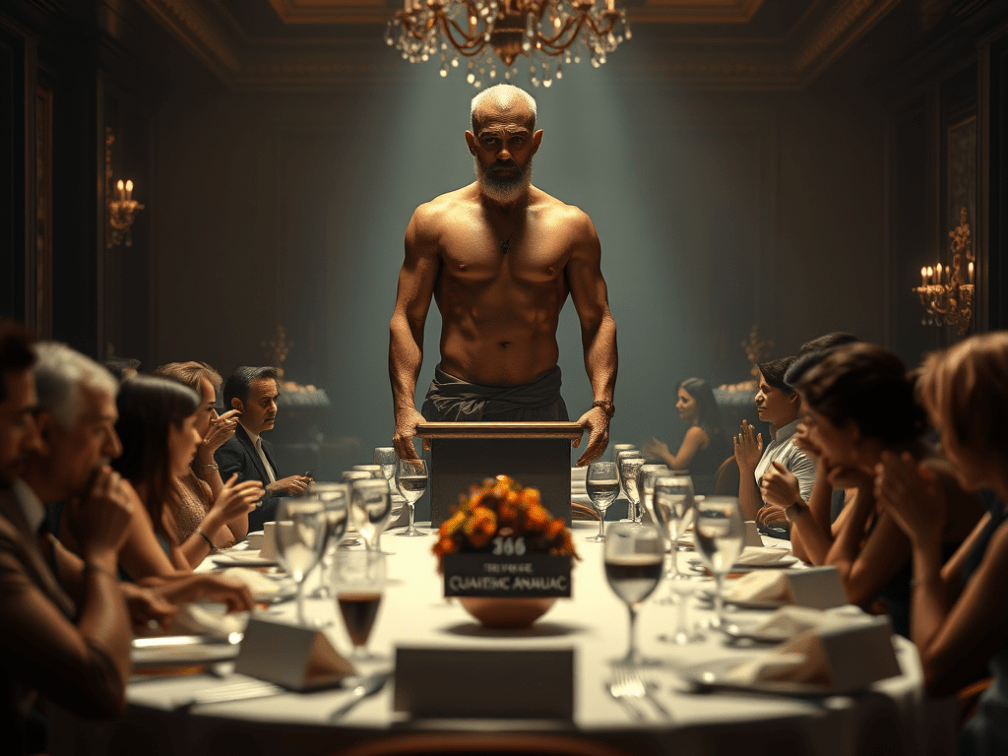
The all but nude subject of our meal opens the table from the divider furthest from me, closing it again when they enter and stand atop the podium in the center. Their well-defined muscle tone pierces through the complexion of age like mountains through clouds. Their thinning hair, cut close to the scalp, is confidently restrained with a barely noticeable salve.
One hand, they raise over the sash, bringing it near their shoulder, the other crosses their waist to rest on their thigh. They align their gaze with the direction of the Sash, never making eye contact. Together now, we are quiet and still, the waves of sound crashing against us until, finally, the others arrive.
I stand up, button my coat around the waist and bow slightly to each one as they approach the table and sit. We exchange pleasantries and discuss the admirable aspects of the dinner subject before turning our glasses over to begin.
“I cannot find peace,” the figure between all of us states plainly. The restaurant falls silent for the performance, “Choices one by one are being taken away.”
Three seats down, one of the guests places their glass at the edge closest to the center, then the next, the next, then myself, and we continue until all the glasses are given up to the individual. A server comes out from some place behind me with a pitcher and waits.
“I want nothing from you. I choose only the single choice you’ve left me,” they say and we take our glasses back. The server approaches the table and pours our drinks in the same order before disappearing behind me.
The noise of the place erupts, our table now contributing to it with discussion about various things. We’ve all ordered days before. Etiquette dictates that the centerpiece not be diminished by anything financial or the time constraints of indecisive eaters.
The guest to my right I find out is a stand-in for a local designer. He would never have been invited otherwise, but I don’t share this insight. I don’t need to, he repeats it several times. To my left is a woman who smiles cordially enough, but doesn’t wish to share anything besides her name, Susan. She is instead eager for the discourse further to her left, and only slightly less frequently for the stolen glances of another guest across the table from me.
Through the thin gap between the subjects legs I can only make out a sharp red shirt and the better part of a gold tie, both enveloped in a burgundy Jacket. I hadn’t noticed them earlier but the implications I see now are jarring.
When our first course arrives, the conversations unravel and the figure shouts, “Is this my dream?” Surrounding them, we whistle twice, the man to my right slightly delayed from the rest of us, following by observation rather than custom. “I hear your songs, drift away. Like dreams, they are not for me,” they reply. The dishes set in front of us are uncovered one by one. Our various meals set out exactly as we had ordered weeks ago and accompanied by the meat of a single chestnut warm enough to grace the air with smoke. The centerpiece extends their hand, open palmed and consumes the steaming morsels as we place them in the open palm.
The guest across from me, it turns out, is quite a worthy distraction. Likely all of us have a considerable amount of wealth dependent on the blessings of his ships, of his harbor. If his choice of clothing bothers the center piece, they don’t indicate it. Breaking custom he presses the nut into their hand and then folds it closed, a momentary swaddling grip held between them. Susan to my left, gasps quietly and shifts in her chair.
There is a tense moment, but the garishly dressed businessman smiles and nods and releases the hand. The figure unfazed, they consume the last nut, and speak again, “That bitter seed is planted. I am the soil. I am the fruit,” and then return to their pose as we eat.
Susan speaks to me about half way through the meal, to find out more about my station. It’s not likely anyone would recognize me, but I recognize them. Everyone but the stand-in. I recognize them by their numbers, their debts and profits, the currents I swim in. The ebb and flow of power that is the economy. I don’t say it this way, but the way I say it she sees the depth of it beneath the words on the surface. The alchemy I do for them, converting chains into ornaments, loses worth once they know it’s worth. So we talk around numbers for a bit instead.
The man to my right is clinging to things, not eating at this point. By the way he is fumbling with the card, mouthing the letters, trying to work out the pronunciation, we all can see what is happening. His envy for the moment being throttled by the reality of it; more aware of the thin membrane that separates all of us than anyone else. More than me, though I’m not completely ignorant of it.
By the time we finish, he’s hardly taken a bite. The server reluctantly takes his plate away after confirming he wants no more. Our 2nd course arrives and he doesn’t even make the attempt, just stares silently at the arrangement in front of him. The centerpiece speaks more quietly now, so we have to strain a bit to hear them, “the anger grows. I see it. The void, hungry, yet full to bursting.” It’s something French, the stand-ins uneaten dish, cuddled by a rich creamy sauce and the subtle smell of mulled wine.
Before taking the last plate away, I pat the stand-in’s leg and offer him a look of assurance. He flinches, his eyes darting to mine, searching for something I can’t offer, “I will not chase the dream. I will not look for peace,” the figure on the podium says while raising their hand in a fist, their gaze following it.
Our server returns with three others and they begin placing another set of covered dishes in front of us. The stand-in jumps a little when his plate settles, “I will make my peace. Who is brave enough to help me?” They lower their hand toward the table, open palm while the servers began to uncover the dessert dishes. Each porcelain plate glitters with the silver of a single gun nestled amongst greenery. All except for the stand-ins, his plate remains bleakly empty.
I cough, stand and button my coat before grabbing the gun on my plate. I walk around the others. When I pass the stand-in I put a hand on their shoulder, a cruelty for sure, but amusing. They jump again, as if on cue, but don’t get up. I turn to face the center figure; on the same level now, as much as we will ever be.
For a moment, I see my reflection there, and beyond that just a glimpse of a thing, who I am, reflected too. Once the feeling dissipates, I present the gun, handle first and say, “I offer you what you know, there can be no peace,” and when they grip the handle the others all open fire. Whatever it is, it’s good enough.


 Grow Gray With Me